
DAC8832EVM-PDK
KIT PERFORMANCE DEMO FOR DAC8832
Description
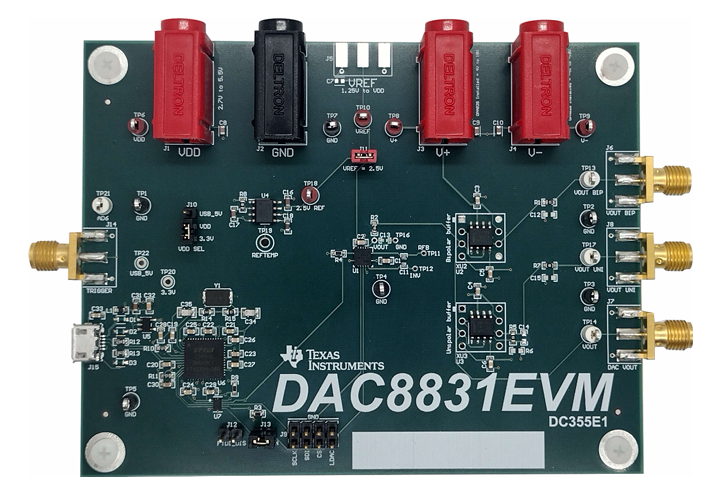
The DAC8831EVM is an easy-to-use platform to evaluate the functionality and performance of the DAC8831 and DAC8832 devices. The DAC8831EVM has optional circuits and jumpers to configure the device for different applications. The DAC8831 comes installed on the EVM; the DAC8832 does not.
Get Started
1. Order the EVM.
2. Configure EVM jumpers.
3. Install the DAC8831EVM GUI from ti.com.
4. Connect USB and external power supplies.
5. Launch the DAC8831EVM GUI.
Features
• Configurable circuit to evaluate the DAC8831
• Onboard VDD (5V or 3.3V) support via USB and onboard voltage regulators
• FT4232 easily writes to the DAC using the DAC8831EVM GUI
• Onboard 2.5V VREF support
• Trigger output is available for synchronous measurement
• External SPI connections available
• SOIC-ADAPTER-EVM included for easy op-amp testing
Applications
• Test equipment
• Data acquisition (DAQ)
• Optical networking
1 Evaluation Module Overview
1.1 Introduction This user's guide describes the characteristics, operation, and recommended use cases of the DAC8831EVM. This document provides examples and instructions on how to use the DAC8831EVM board and included software. Throughout this document, the terms evaluation board, evaluation module, and EVM are synonymous with the DAC8831EVM. This document also includes schematics, the reference printed circuit board (PCB) layouts, and a complete bill of materials (BOM).
1.2 Kit Contents
Table 1-1 details the contents of the EVM kit. Contact the TI Product Information Center at (972) 644-5580 if any component is missing. Download the latest versions of the related software on the TI website
1.3 Specification
The EVM is intended to provide basic functional evaluation of the device. The layout is not intended to be a model for the target circuit, nor laid out for electromagnetic compatibility (EMC) testing. The EVM consists of a printed-circuit board (PCB), which has the DAC8831 installed.
1.4 Device Information
The DAC8831 and DAC8832 are single, 16-bit, serial-input, voltage-output digital-to-analog converters (DACs) operating from a single 3V to 5V power supply. These converters provide excellent linearity (1LSB INL), low glitch, low noise, and fast settling (1.0μs to 1/2LSB of full-scale output) over the specified temperature range of –40°C to +85°C. The output is unbuffered, which reduces the power consumption and the error introduced by the buffer.
These parts feature a standard high-speed (clock up to 50MHz), 3V or 5V SPI serial interface to communicate with a DSP or microprocessor.
The devices provide bipolar output (±VREF) when working with an external buffer. The DAC8831 resets to zero code after power up. The DAC8832 resets to midscale code after power up. For optimized performance, a set of Kelvin connections to external reference and analog ground input are provided on the devices.
2 Hardware
2.1 Hardware Setup
This section describes the overall system setup for the EVM. A computer runs software that communicates with the FTDI controller onboard using SPI protocol. External power supplies is required for certain output configurations.
2.1.1 Hardware Theory of Operation
The DAC8831EVM is connected to the computer through the onboard FTDI digital controller using the USB cable that is supplied with the EVM. The evaluation board features connectors and test points for all communication lines, DAC outputs, and supplies. Figure 2-1 shows a block diagram of the DAC8831EVM.
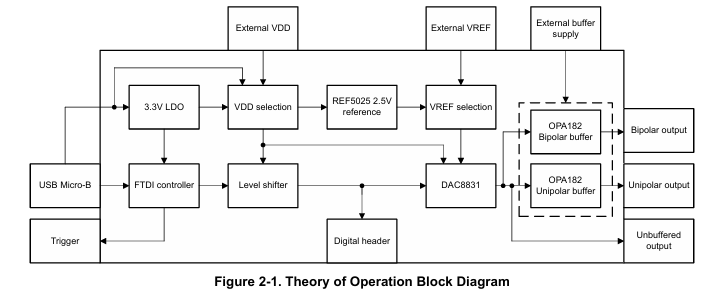 The USB connection provides the 5V supply to the EVM. Voltage regulators generate 3.3V from the USB 5V
supply. This 3.3V supply is used to power the FTDI controller.
The USB connection provides the 5V supply to the EVM. Voltage regulators generate 3.3V from the USB 5V
supply. This 3.3V supply is used to power the FTDI controller.
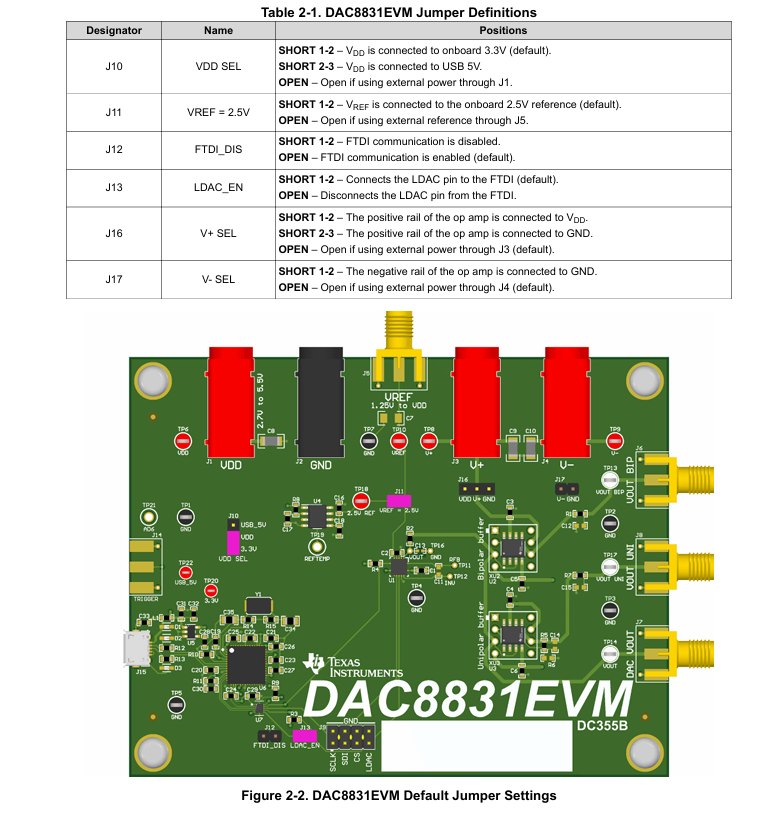
The VDD supply can use the onboard 5V or 3.3V supplies depending on the J10 jumper setting. By default, VDD is connected to the onboard 3.3V supply. Alternatively, VDD can be supplied externally through banana jack J1. Remove the jumper connector on J10 before connecting external supplies to VDD.
The device VREF is supplied by the onboard 2.5V voltage regulator (by shorting jumper J11), or from an external supply (with SMA connector J5).
Each of the DAC outputs have footprints available for capacitor and resistor loads that are unpopulated by default.
2.1.2 Jumper Definitions
Table 2-1 provides the details of the configurable jumper settings of the DAC8831EVM. Figure 2-2 shows the default jumper connections on the board.
- 苏州杭晶电子入驻工之芯商城,成为优质供应商
- TPS7A30-49EVM-567_TI(德州仪器)中文资料_英文资料_价格_PDF手册
- TLA2024EVM-PDK_TI(德州仪器)中文资料_英文资料_价格_PDF手册
- INA229_239EVM_TI(德州仪器)中文资料_英文资料_价格_PDF手册
- DAC8832EVM-PDK _TI(德州仪器)中文资料_英文资料_价格_PDF手册
- LP8557IEVM_TI(德州仪器)中文资料_英文资料_价格_PDF手册
- LAUNCHXL-F28027F TI(德州仪器)中文资料_英文资料_价格_PDF手册
- DLPDLCR160CPEVM DLP160CP TI(德州仪器)中文资料_英文资料_价格_PDF手册
- THS4631DDAEVM TI(德州仪器)中文资料_英文资料_价格_PDF手册
- DAC3482EVM TI(德州仪器)中文资料_英文资料_价格_PDF手册
- THS4302EVM TI(德州仪器)中文资料_英文资料_价格_PDF手册
- ADS7038Q1EVM-PDK_TI(德州仪器)中文资料_英文资料_价格_PDF手册
- LM3450AEV230V30/NOPB_TI(德州仪器)中文资料_英文资料_价格_PDF手册
- TPS72728DSEEVM-406_TI(德州仪器)中文资料_英文资料_价格_PDF手册
- WL1835MODCOM8A_TI(德州仪器)中文资料_英文资料_价格_PDF手册
 工商网监
工商网监