
DAC5689EVM
1 Overview
1.1 Purpose
The DAC5668/88/89EVM provides a platform for evaluating the DAC5668, DAC5688, and DAC5689 digital-to-analog (DAC) converter under various signal, reference, and supply conditions. All three DACs are dual channel, 800MSPS interpolating DACs with DAC5668 being a 12-bit DAC and DAC5688/DAC5689 being 16-bit DACs. Also, both the DAC5668 and the DAC5688 have internal PLL/VCO, which is useful when a high-rate clock is not available at the system level. The table below summarizes the comparisons among the DAC family. The evaluation module also allows designers to analyze either a transformer-coupled output from the DAC or an RF-modulated output using Texas Instruments (TI) TRF3703 analog quadrature modulator. Use this document with the EVM schematic diagram and the corresponding device datasheet.
1.2 EVM Basic Functions
Digital inputs to the DAC can be provided with CMOS-level signals up to 250 MSPS through two 34-pin headers. The analog outputs from the DAC are available via SMA connectors. Because of its flexible design, the analog outputs of the DAC device can be configured to drive a 50-Ω terminated cable using a 4:1 or 1:1 impedance ratio transformer, or single-ended referred to AVDD. The EVM also allows for an option to use TI’s TRF3703 analog quadrature modulator to mix the DAC outputs to RF.
The EVM also includes a TI CDCM7005 clock distribution device to clock the system. The CDCM7005 can be used with an onboard VCXO for full PLL functionality or with an external signal source, in which case the CDCM7005 functions as a buffer.
Power connections to the EVM are via banana jack sockets. In addition to the internal bandgap reference provided by the DAC device, the EVM allows an external reference to be provided to the DAC.
The DAC5668/88/89EVM allows the user to program the DAC and CDCM7005 registers through a USB port. The interface allows read and write access to all the DAC5668/88/89 registers and write-only access to the CDCM7005 registers.
1.3 Power Requirements
The DAC5668/88/89EVM requires 1.8-Vdc and 3.3-Vdc supplies for normal operation. An additional 5-Vdc supply is required to power up the TRF3703 for RF measurements.
2 Software Installation
The DAC5668/88/89EVM comes with a software package that allows the user to configure the DAC and CDCM7005 registers, save and load register settings to/from text files, and visualize the data path through the DAC. Communication with the EVM is achieved through a USB port on the host PC. The DAC5668 and the DAC5688 shares the same EVM software since both DACs have internal PLL/VCO. The DAC5689 has a stand-alone EVM software.
2.1 Minimum Requirements
Before installing the software, verify that the PC meets the following requirements:
• Microsoft Windows™ 2000 or later operating system
• 1024 × 768 screen resolution for optimal viewing
• USB 1.1 or later compatible input port
Other configurations may work; however, they remain untested.
3 DAC5668/88/89EVM Description
The DAC5668/88/89EVM provides a robust and flexible evaluation system for the 800-MSPS interpolating DAC5668, DAC5688, and DAC5689 DAC family. In addition to the DAC5668/88/89, the EVM includes a CDCM7005 for clock distribution and a TRF3703 analog quadrature modulator path for RF measurements. For a complete hardware description, consult the schematics and layout sections at the end of this guide. See the DAC5668, DAC5688, DAC5689, CDCM7005, and TRF3703 data sheets for more information on each device
3.1 Texas Instruments Components on the DAC5668/88/89EVM
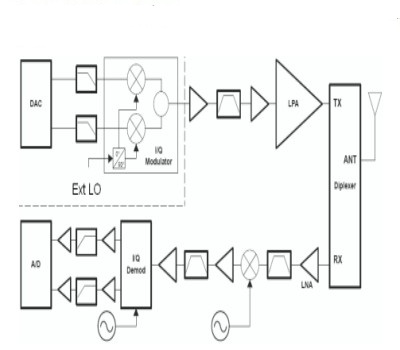
A basic radio system block diagram is shown in Figure 4. The dashed-line box illustrates where the EVM fits in the system.
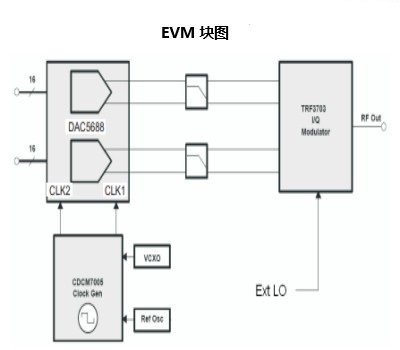
The block diagram of the EVM is shown in Figure 5. As illustrated on the block diagram, the DAC5668/88/89EVM includes three Texas Instruments components that make the entire solution an excellent choice for radio systems.
3.1.1 DAC5668/88/89
The DAC5668/88/89 are dual-channel, 800-MSPS interpolating DACs with dual CMOS digital data bus, integrated 2x-8x interpolation filters, a fine frequency mixer with 32-bit complex numerically controlled oscillator (NCO), IQ compensation, and internal voltage reference. Different modes of operation enable or bypass various signal processing blocks. The DAC5668 and the DAC5688 also include an internal 2x-32x clock multiplying PLL/VCO. This feature is useful when a high-rate clock is not available at the system level.
The DAC5668/88/89 dual-CMOS data bus provides 250-MSPS input data transfer per DAC channel. Several input data options are available: dual-bus data, single-bus interleaved data, even and odd multiplexing at half-rate, and an input FIFO with either external or internal clock to ease interface timing. Input data can be interpolated 2x, 4x, or 8x by onboard digital interpolating FIR filters with over 80 dB of stop-band attenuation.
The DAC5668/88/89 allows both complex and real output. An optional 32-bit NCO/mixer in complex mode provides frequency upconversion and the dual DAC output produces a complex Hilbert Transform pair. A digital inverse sinc filter compensates for natural DAC Sin(X)/X frequency rolloff. The digital Quadrature Modulator Correction (QMC) feature allows IQ compensation of phase, gain, and offset to maximize sideband rejection and minimize LO feedthrough of an external quadrature modulator performing the final single-sideband RF upconversion.
3.1.2 CDCM7005
The CDCM7005 is a high-performance, low-phase noise and low-skew clock synchronizer that synchronizes a VCXO (voltage-controlled crystal oscillator) or VCO (voltage-controlled oscillator) frequency to a reference clock. The CDCM7005 is used to generate and synchronize the clock outputs to the system. The device has five outputs which can be configured to LVPECL or LVCMOS levels and can be divided down by 1, 2, 3, 4, 6, 8, and 16. The divide by 16 can be replaced with a divide by 4 or 8 with a 90 degree phase shift.
3.1.3 TRF3703
The TRF3703 is a very-low-noise direct quadrature modulator, capable of converting complex modulated signals from baseband or IF directly up to RF based on the LO frequency.
- TI(德州仪器)中文资料_英文资料_价格_PDF手册
- ADS7038Q1EVM-PDK_TI(德州仪器)中文资料_英文资料_价格_PDF手册
- LM3450AEV230V30/NOPB_TI(德州仪器)中文资料_英文资料_价格_PDF手册
- TPS72728DSEEVM-406_TI(德州仪器)中文资料_英文资料_价格_PDF手册
- WL1835MODCOM8A_TI(德州仪器)中文资料_英文资料_价格_PDF手册
- TAS5424BQ1DKDEVM_TI(德州仪器)中文资料_英文资料_价格_PDF手册
- ADS7042EVM-PDK_TI(德州仪器)中文资料_英文资料_价格_PDF手册
- TMDS570LS31HDK_TI(德州仪器)中文资料_英文资料_价格_PDF手册
- VCA8500BOARD_TI(德州仪器)中文资料_英文资料_价格_PDF手册
- DEM-SOT223LDO_TI(德州仪器)中文资料_英文资料_价格_PDF手册
- DAC8564EVM_TI(德州仪器)中文资料_英文资料_价格_PDF手册
- ADS8412EVM _TI(德州仪器)中文资料_英文资料_价格_PDF手册
- TPS61500EVM-369_TI(德州仪器)中文资料_英文资料_价格_PDF手册
- TPS7A6050EVM_TI(德州仪器)中文资料_英文资料_价格_PDF手册
- ADC3244EVM_TI(德州仪器)中文资料_英文资料_价格_PDF手册
 工商网监
工商网监